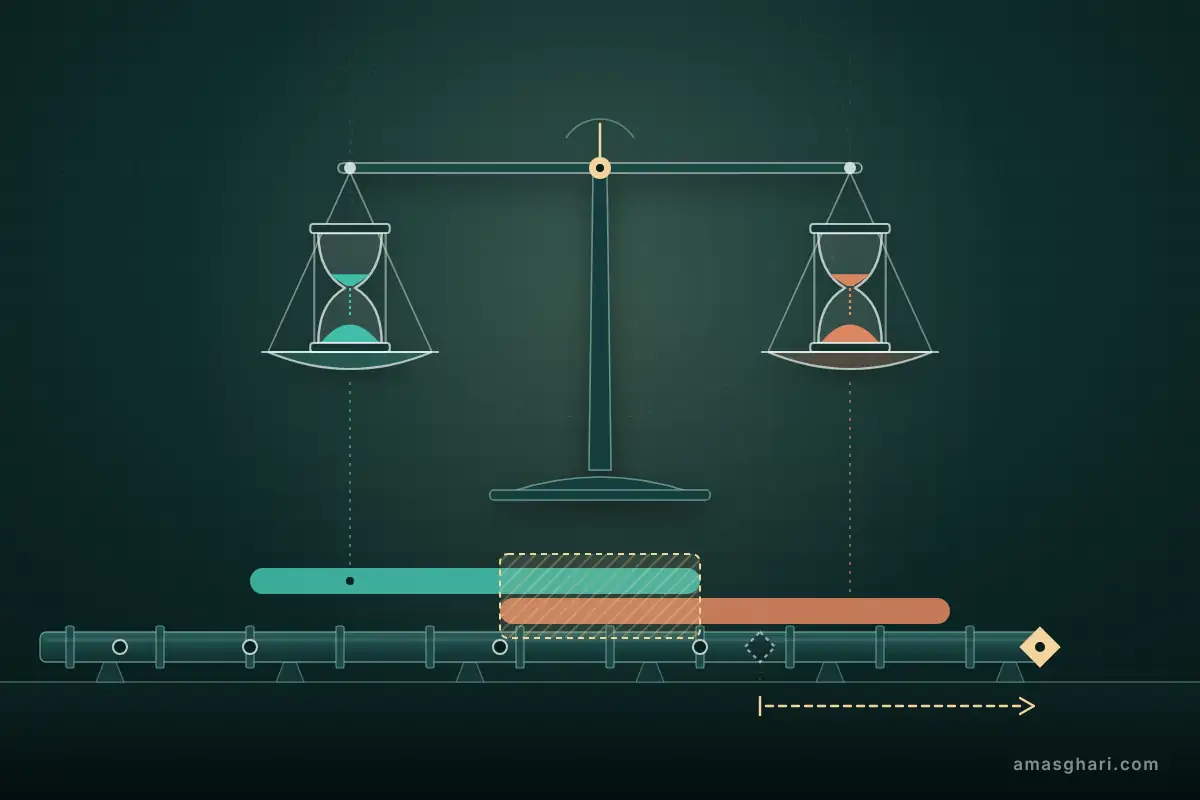
Two things go wrong on site in the same month. The Employer hands over a section of the pipeline route four months late. Meanwhile the Contractor’s pipe supplier misses its delivery window by three months. Both sit on the critical path. Whose delay is it?
That is the concurrent delay question, and a large share of extension of time (EOT) disputes end up there. The answer decides more than time. It decides whether the Employer can levy Delay Damages for the overlap, and whether the Contractor recovers its prolongation costs.
The 2017 FIDIC Red, Yellow and Silver Books addressed concurrency for the first time, in the final paragraph of Sub-Clause 8.5. They did not settle it, though. They handed the decision back to the parties, and most parties never take it.
What Sub-Clause 8.5 actually says
Where a delay caused by a matter that is the Employer’s responsibility is concurrent with a delay caused by a matter that is the Contractor’s responsibility, Sub-Clause 8.5 says the Contractor’s EOT is to be assessed under the rules and procedures in the Special Provisions. If the Special Provisions say nothing, the fallback is to assess it “as appropriate taking due regard of all relevant circumstances”.
FIDIC drafted it this way deliberately. Its guidance explains that there is no internationally accepted standard rule on concurrency, so the parties are invited to agree their own. The clause is really a prompt to decide at tender stage.
Two consequences follow:
- The fallback is a standard, not a rule. “All relevant circumstances” gives the Engineer, the DAAB and eventually an arbitral tribunal wide discretion. Neither side can predict the outcome with much confidence.
- Sub-Clause 8.5 deals with time only. It says nothing about money. Whether the Contractor recovers Cost for the concurrent period depends on the clause giving the entitlement, the governing law and whether the costs can be traced to the Employer’s event alone.
Three approaches your Special Provisions could adopt
In practice the drafting choice comes down to three positions. Each one favours a different party.
| Approach | How it works | Who it favours | Reference point |
|---|---|---|---|
| Time but no money | The Contractor gets an EOT for the concurrent period, so no Delay Damages, but recovers prolongation cost only where it can separate the cost caused by the Employer’s event | Broadly balanced | SCL Delay and Disruption Protocol, 2nd edition (2017) |
| No time | Concurrent delay is excluded from the EOT assessment, so the Contractor carries Delay Damages for the overlap | Employer | Upheld by the English Court of Appeal in North Midland v Cyden Homes (2018) |
| Apportionment | Delay, and sometimes cost, is split according to the relative weight of each cause | Depends on the facts | Applied by some courts and tribunals; the least predictable of the three |
The Society of Construction Law’s Protocol takes the first position. Where Contractor delay to completion coincides with Employer delay to completion, the Contractor’s delay should not reduce the EOT due. The Protocol also defines concurrency narrowly: both the Employer risk event and the Contractor risk event must be an effective cause of delay to completion.
The second position comes from North Midland Building Ltd v Cyden Homes Ltd [2018] EWCA Civ 1744. An amended JCT contract said that delay caused by a Relevant Event would not be taken into account where it was concurrent with delay for which the Contractor was responsible. The Contractor argued that the prevention principle made the clause ineffective. The Court of Appeal disagreed and enforced it. The commercial effect was stark: the Contractor applied for an EOT of about six months and was granted nine days.
Treat that case carefully outside England. It is an English-law decision on a JCT form. On FIDIC contracts governed by civil law, which covers much of the MDB-financed work in Türkiye, Central Asia and the Middle East, the local rules on delay damages, good faith and contractual penalties may produce a different answer. That is a question for local counsel, not for a template.
“Concurrent” is narrower than most claims assume
A lot of what gets pleaded as concurrency is really sequential delay. On the narrow definition used by the English courts and the Protocol, true concurrency needs two causes of approximately equal causative potency, both actually delaying completion.
Go back to the opening example. If access was four months late and the pipe supply three months late from the same start date, the pipe delay may never have reached completion at all. The work was waiting for access either way. An Employer that calls this concurrency is usually trying to cancel out a clean EOT. The reverse also happens: contractors reach for concurrency when their own delay was the dominant one.
The practical lesson is that concurrency is a finding from a delay analysis on a reliable programme. It is not a label to put on a claim, or on a rejection. That makes the Sub-Clause 8.3 programme, and keeping it updated, far more important than most site teams treat it.
What contractors should do
- Read Part B before you price. If the Special Provisions adopt the no-time approach, that is a priced risk. On MDB tenders a qualification can make the bid non-responsive, so raise it as a clarification during the bidding period or price it.
- Keep the programme alive. An accepted Sub-Clause 8.3 programme, updated every reporting period, is the baseline for any concurrency argument, yours or the Employer’s.
- Be candid about your own delays. Report and mitigate Contractor-caused slippage in the monthly progress reports. An undisclosed delay that surfaces at determination stage does more damage than one reported early.
- Ring-fence time-related costs. If you expect time but no money for concurrent periods, record prolongation costs by activity and period so you can show which costs the Employer’s event caused on its own.
- Use advance warning. Sub-Clause 8.4 obliges both Parties to warn of probable future delay. A warning on record helps fix which event came first and which one drove completion.
What Employers and Engineers should do
- Decide at drafting stage. Silence leaves the outcome to “all relevant circumstances”. Pick an approach and write it into Part B in plain words. On MDB-financed contracts, check what the financier’s standard documents allow you to amend first.
- Do not over-reach. A no-time clause moves a large risk to the Contractor. Experienced bidders will price it, and the Employer pays for that protection whether or not concurrency ever arises.
- Determine concurrency with analysis, not assertion. A Sub-Clause 3.7 determination that simply says the delays “were concurrent”, with no programme analysis behind it, is unlikely to survive a DAAB referral.
- Hold back on Delay Damages until the EOT is determined. Deducting damages for a period that is later found to be Employer delay invites a further claim, with financing charges.
How to measure it
A few indicators show whether a project can actually resolve a concurrency argument:
- Percentage of EOT claims supported by a delay analysis on the current accepted programme (target: all of them).
- Age of the latest accepted programme update (target: no older than one reporting period).
- Share of rejected EOT days where concurrency is the stated ground for rejection.
- Average days between a delay event and its first documented delay assessment.
The bottom line
Sub-Clause 8.5 did not solve concurrent delay. It moved the decision into the Special Provisions. When those are silent, both Parties are betting on a discretionary standard that the Engineer, the DAAB and an arbitrator may each apply differently. Settle the rule before the contract is signed, then build the programme and records that will show what really drove completion.
If you are drafting Particular Conditions, assessing an EOT claim or answering a concurrency argument and want an independent view, get in touch at amirmehdi@amasghari.com.
This article is general information, not legal advice. The treatment of concurrent delay depends on the Particular Conditions and the governing law of each contract. Check your contract and take specific advice before acting.
Sources
- North Midland Building Ltd v Cyden Homes Ltd [2018] EWCA Civ 1744 (National Archives)
- Fenwick Elliott, The SCL Delay and Disruption Protocol: a second edition
- Gowling WLG, FIDIC claims for time (2024)
- Haynes Boone, Time Is Not On Your Side: A Quick Overview of Delay (July 2019)
- Watson Farley and Williams, Preventing operation of the prevention principle (August 2018)
- Mondaq, case note on North Midland Building Ltd v Cyden Homes Ltd