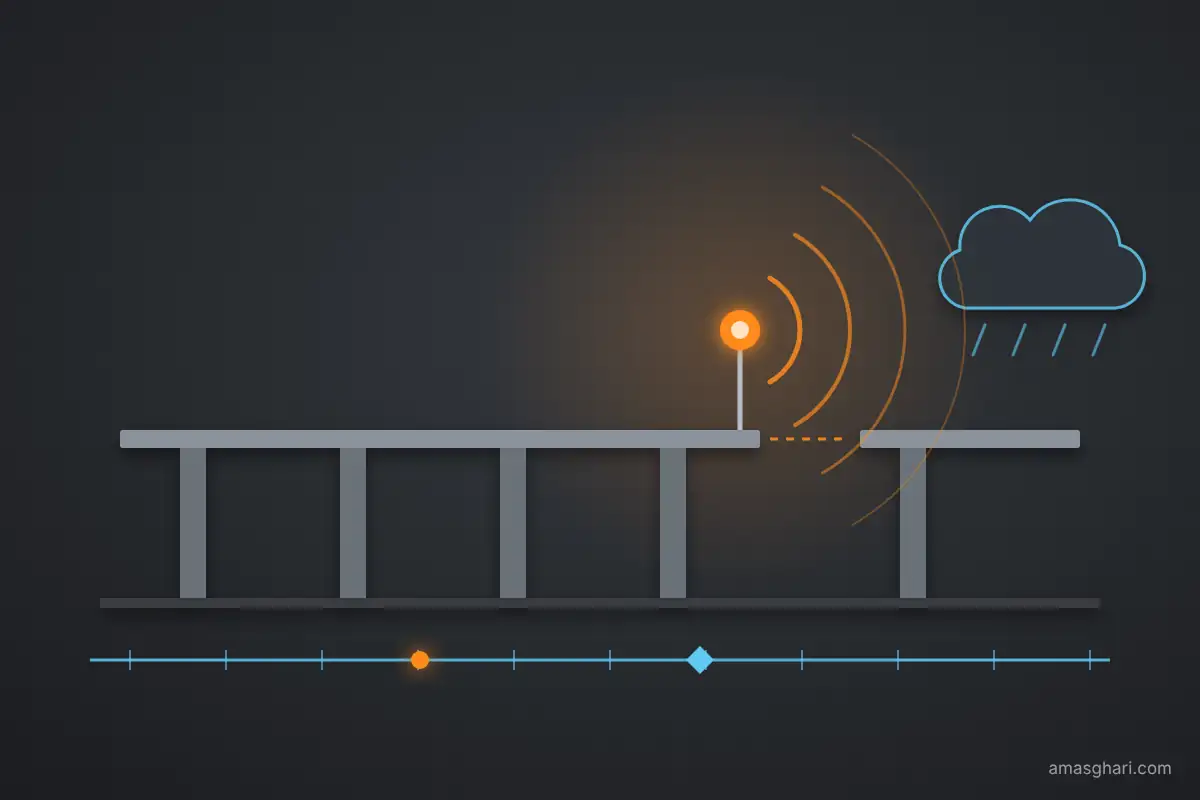
Month nine on a road project. The Contractor’s planner can see that a utility diversion run by a third party is slipping, and that the river crossing will now drift into the wet season. The Engineer’s team knows a redesign of the bridge abutments is still under review. Nobody puts any of it in writing, and nobody gives a FIDIC advance warning.
Six weeks later the first formal document anyone sees is a Notice of Claim. By then the wet season has arrived, the abutment design is late, and every option that was cheap in month nine is gone.
The 2017 FIDIC Red and Yellow Books contain a mechanism built for month nine: advance warning under Sub-Clause 8.4. It is the notice before the notice, and on most projects it is the cheapest dispute-avoidance tool in the contract.
What Sub-Clause 8.4 actually says
Under the 2017 Red Book General Conditions, each Party must advise the other and the Engineer, and the Engineer must advise the Parties, in advance of any known or probable future events or circumstances which may:
- adversely affect the work of the Contractor’s Personnel;
- adversely affect the performance of the Works when completed;
- increase the Contract Price; and/or
- delay the execution of the Works or a Section.
The second sentence matters as much as the first. The Engineer may ask the Contractor to submit a proposal under Sub-Clause 13.3.2 [Variation by Request for Proposal] to avoid or minimise the effects of the event. A warning is therefore meant to open a conversation about options, not just to put a risk on file.
Two features are worth noting. The duty is mandatory: the 2016 pre-release draft only asked the Parties to endeavour to advise, and the 2017 text says “shall”. And the Engineer is caught too, even though it is not a Party.
What changed from the 1999 books
Early warning is not new to FIDIC. In the 1999 Red and Yellow Books it sat inside Sub-Clause 8.3 [Programme] and was an obligation on the Contractor alone. The 2017 editions moved it into its own Sub-Clause and made it mutual.
| Feature | 1999 Red/Yellow Books | 2017 Red/Yellow Books |
|---|---|---|
| Location | Within Sub-Clause 8.3 [Programme] | Stand-alone Sub-Clause 8.4 [Advance Warning] |
| Who must warn | The Contractor | Each Party, and the Engineer |
| Express sanction for not warning | None stated | None stated |
A warning is not a Notice of Claim
This is the point site teams most often get wrong. An advance warning under Sub-Clause 8.4 does not protect an entitlement. If an event entitles the Contractor to time or money, the Notice of Claim under Sub-Clause 20.2.1 is still due within 28 days of the date the Contractor became aware, or should have become aware, of the event. Progress reports and programme updates are not Notices either.
The two are connected, though. A warning describes something that may happen; a Notice of Claim follows once it has happened and has an effect. On a well-run project the claim register should show most claims preceded by a warning. I explain the 28-day clock and the other time bars in FIDIC Claims on World Bank-Financed Projects: Three Clocks Every Contractor Must Watch.
There is one indirect link worth knowing. If a Notice of Claim is late, Sub-Clause 20.2.5 lets the Engineer consider, among other things, whether the other Party had prior knowledge of the event. Commentators have suggested that regular programme updates and similar records may help show that knowledge. A documented warning is that kind of record. It is no substitute for a timely Notice.
What happens if nobody warns?
On the face of the General Conditions, nothing specific. Commentators agree that Sub-Clause 8.4 has no stated consequence for a failure to warn and no time limit for giving one. That contrasts with the NEC forms, where a Contractor that fails to give an early warning it should have given can have its compensation assessed as if the warning had been given.
Three caveats keep this from being a free pass:
- Particular Conditions. Some commentators expect Employers to amend 8.4 to reduce relief where a Contractor failed to warn. Read Part B before assuming there is no sanction.
- Governing law. It is still a contractual duty, and where good faith is a legal duty, as in many civil-law systems, a duty to warn may arise anyway. How a tribunal treats a breach depends on that law. Ask local counsel.
- Credibility. In my experience, a party that saw a problem coming and stayed silent has a harder time persuading an Engineer or DAAB on its later claim or defence. That is a practical point, not a rule of the contract.
Why it is the cheapest dispute-avoidance tool
A warning costs one email and ten minutes at a meeting. What it buys is time while choices are still open: resequencing, a design decision brought forward, a Variation priced before the work starts rather than argued after. Early warnings let the Employer reconsider an issue before it escalates.
Warnings also make later delay analysis easier. When events are logged as they emerge, it becomes much simpler to show which one came first and which one drove completion, the question at the heart of most concurrent delay arguments under Sub-Clause 8.5.
Running advance warning on site
FIDIC does not require a register or dedicated meetings. Both are good practice, and the contract gives you the hooks:
- A shared register. One line per warning: date, who raised it, the 8.4 limb affected, likely effect, owner, next action, and whether it later became a Variation or a Notice of Claim.
- Sub-Clause 3.8 meetings. The Engineer or the Contractor’s Representative can call a management meeting to discuss arrangements for future work. Make the warning register a standing item.
- The Sub-Clause 8.3 programme. The Contractor must submit a revised programme whenever the current one stops reflecting actual progress, and the supporting report must set out proposals to overcome delays. Tie each live warning to the activities it threatens.
- Sub-Clause 4.20 progress reports. Monthly reports must already describe events that may adversely affect completion. Cross-refer to the register so the two never contradict each other.
What contractors should do
- Warn in writing, early and briefly. Name the event, the 8.4 limb, the likely effect and what you propose. Do not wait for certainty.
- Run the claim clock separately. Diarise the 28-day Notice of Claim from the moment the event occurs. A warning never stops it.
- Warn about your own risks too. Supplier slippage and labour shortages are 8.4 events. Raising them early builds the credibility you will need on the Employer’s events.
- Answer 13.3.2 requests properly. A priced, programmed proposal turns a warning into a decision the Engineer can make.
What Employers and Engineers should do
- Warn as well as receive. Late permits, land acquisition, design reviews and funding steps on MDB-financed projects are Employer-side events. The Engineer’s own duty to advise covers what it knows.
- Respond to every warning. Record a decision: accept the risk, request a 13.3.2 proposal, instruct, or close it. An unanswered warning helps nobody.
- Do not punish candour. If every warning is treated as a claim in disguise, the Contractor will stop giving them.
- Decide on sanctions at drafting stage. If you want a consequence for failing to warn, write it into Part B clearly, and check what the financier’s standard documents allow first.
How to measure it
- Warnings raised per month, split by Contractor, Employer and Engineer (a register where only one side warns is a warning sign in itself).
- Share of Notices of Claim preceded by an advance warning on the same event.
- Median days from warning to a recorded decision.
- Share of warnings closed without a claim, by mitigation, a priced Variation or the risk not materialising.
The bottom line
Sub-Clause 8.4 carries no express sanction, which is why so many projects ignore it. That is a mistake. FIDIC advance warning is the point in the contract where problems are still cheap, and the 2017 books made it everyone’s job. Keep the warning and the Notice of Claim on separate tracks, give the register a seat at every management meeting, and measure whether it is being used.
If you want help setting up an advance warning process, or an independent view on a dispute where warnings were or were not given, get in touch at amirmehdi@amasghari.com.
This article is general information, not legal advice. Clause references are to the 2017 FIDIC Red and Yellow Books General Conditions; the effect of Sub-Clause 8.4 on your project depends on the Particular Conditions and the governing law. Check your contract and take specific advice before acting.
Sources
- Fenwick Elliott (Jeremy Glover), Some thoughts on how the 2017 FIDIC contract deals with time (2018)
- Gowling WLG, FIDIC claims for time (2024)
- Clyde & Co, FIDIC Quick Reference Guide: Yellow Book 2017
- Fenwick Elliott (Nicholas Gould), The new 2017 FIDIC Red, Yellow and Silver Books, SCL (2018)
- Peter Atkinson (HKA), FIDIC 2017 presentation, IPBA Manila (2018)
- CMCS, Managing FIDIC 2017 early warning provisions in construction projects